Monday, August 11, 2014

Modern Print Monday: Estelle Laverne

Three versions of Estelle Laverne's Fun to Run
print inspired by Matisse.


Estelle Laverne (1915-1997) with her husband and
partner Erwine Laverne. Behind them a piece
of Atmospheric #1 

Atmospheric #1


The Lavernes  founded design business Laverne Originals in 1938 and
are best remembered today for their plastic invisible chairs such as
"Lily" above, manufactured in the late 1950s and '60s.

They also produced wallpaper and fabric, some of which is attributed to Estelle.

Trapeze
Their fabric is usually screen printed on mixed fabrics of rayon, linen or and/or fiberglass.

Trapeze is on the left in this article on modern fabric in 
Life Magazine 1954

Laverne prints were also done by
other artists such as Alexander Calder
and Ray Komei ,who did the popular Masks
print above for their Contempora series.


Read a biography in the New York Times:

http://www.nytimes.com/2004/04/18/magazine/the-invisibles.html?src=pm&pagewanted=1

See another Laverne print at the Cooper Hewitt website:

https://collection.cooperhewitt.org/objects/18398661/ 

Thursday, August 7, 2014

Trellis: Modern/Not Modern?

Modern as a lattice pattern looks
there is a conflict (if one were a stickler for modernism.)


Vienna's Schönbrunn Palace is a late -18th-century garden of lattice.

One of the basic principles of modernism is "Make it New," to quote Ezra Pound. The trellis is a revival...a Romantic revival at that.
Salon de treillage
(Trellis room)
Treillage was the ultimate in ostentatious European taste
that Modernists were rebelling against.

Robert M. Kelly writing about the pattern in the Old House Journal remarks on how the Romantic poets were stunned by the idea of a trellis wallpaper bringing beloved nature into the home. When Percy Shelley first saw trellised wallpaper festooned with flowers and grapes in London about 1800 he had to touch it and then said (poetically), "We must stay here; stay for ever."

Read Kelly's article at this link:
http://www.oldhousejournal.com/bold_frameworks_of_design/magazine/1317

A painted screen found in New Orleans
shows the French influence

Design for Trellis wallpaper by William Morris
1862
Fifty years later the trellis was still fashionable enough for it to figure in William Morris's early wallpaper designs

Trellis wallpaper

Jasmine Trellis by William Morris
The interplay of organic line over structured
grid is interesting, but is it modern?

I've been posting about trellis pattern, probably because like Elsie de Wolfe I was frightened by the wallpaper when I was a child. I do recall a trellis with ivy in the kitchen.

Contemporary sort of 3-D bamboo and wisteria look

I'm still frightened by lattice wallpaper.

Vintage fashion for pottery and trellis

Fabric from a mid-20th-century dress


Napoleonic bees in an Empire revival paper

Can there be a Romantic Modernism?
Or is it an oxymoron?

Monday, August 4, 2014

Modern Print Monday: André Durenceau

Pochoir (stencil print) from Inspirations, 1928


Although born in Auray, France, Durenceau's art career was in the United States, where he moved in the 1923. Virginia Gardner Troy in The Modernist Textile: Europe And America characterizes him as a French textile designer.


He published a book of plates Inspirations, using the pochoir technique, which is French for stencil.


Each plate was in essence an original print with vibrant color.

Poster for the New York World's Fair in 1939
where Durenceau painted murals.

Durenceau's color influenced technicolor movies, illustration, murals and the whole idea of
a vivid streamline style of the 1930s and '40s.


Queen Elizabeth by Durenceau in the 1950s


Thursday, July 31, 2014

Lattice Quilts

If lattice or trellis pattern was so popular in prints it might have been popular in patchwork.
In my BlockBase program I did a wildcard search for the word lattice and found 16 patterns with that word in the name

Only two for "Trellis"

I chose "Quick Quilt" from the Menu and saw how a grid of multiple blocks would look. This "Square Lattice" from the Nancy Cabot column in the Chicago Tribune would definitely qualify as a trellis or lattice.


BlockBase #4110 was also by Nancy. She called it Nauvoo Lattice.

Here's one you could possibly piece called Basket Lattice from the Ladies Art Company in the early 20th century (BlockBase #452.) I've never seen anyone try it though.

This is more pieceable---Arabic Lattice.
The BlockBase # is 2561 and there are several ways to arrange the block.


I don't credit it to Ruby McKim in BlockBase
but I probably should have. It's a clever
pattern,

but like the others, not too popular in the early 20th century.
This very pink version is from Cindy's Antiques.


Monday, July 28, 2014

Modern Print Monday: Tony Duquette


An exotic lattice/trellis print from a Tony Duquette design
by Jim Thompson.

Tony Duquette (1914-1999) with Elsie De Wolfe in 1947

Tony Duquette doesn't seem to have designed any repeat pattern fabrics but he has been a great influence lately, particularly on the lattice imagery we see everywhere

Duquette created total fantasy environments in his interiors and exteriors.

 The above two lattice-works are from his own homes.
He used lattice to add a opulent Asian look.

He was a protege of Elsie De Wolfe, 
worked in film and theater and as a sort of installation artist.

Cobina Wright's living room with a Paris Snowflake Screen
and other Duquette fancies


The name of this book on Duquette---More is More,
seems to capture the whole concept.

Check out http://tonyduquette.com/
.

Thursday, July 24, 2014

Modernism & McKim

Winifred Avery and the unnamed Modern Priscilla
designer I've been discussing in the past few weeks
may have envied Ruby Short McKim's success in
appealing to the 1920-40 quilt audience with
her modern designs.


Although McKim's designs were difficult to piece
and rather radically new, many quilts were made.


McKim seems to have figured out the winning mix
of sentiment, tradition and modernism.
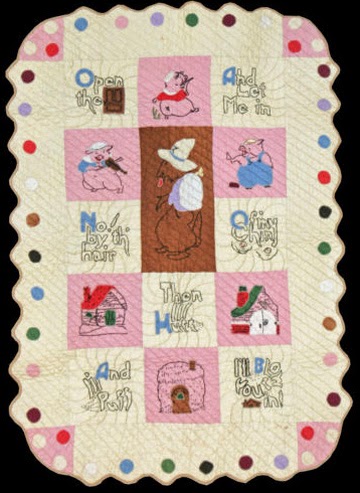
Her "Three Little Pigs" applique and embroidery
was quite popular based on the evidence of surviving examples.


Was it novelty, good design or marketing
that made McKim Studios such a success?


See the McKim Studios website here: