Monday, September 15, 2014

Modern Print Monday: Hector Guimard

Wallpaper by Hector Guimard
Paris, 1898

Hector Guimard, 1867-1942
Guimard was primarily an architect.

Wallpaper for the Castel Beranger, 1898
  
Castel Beranger
One of the things I wanted to see when I went to Paris this
summer was work by Hector Guimard,

most famous for his Paris Metro stations.

They are Art Nouveau magic.


I'd hoped that Guimard also designed textiles,
but found only that he did a limited amount of repeat pattern
wall paper, as at the top of the page.


He also embroidered his sinuous lines. He embroidered this silk on
linen handkerchief for his wife when they married.


The Metropolitan Museum of Art has several Guimard pieces:

As does the Cooper-Hewitt:


He designed furniture upholstery too

but no repeat pattern textiles that I could find.

Hotel Mazarra

I came across some buildings walking around near the Seine. They are distinctive and often signed. What a delightful surprise.


And online I found a new silk scarf printed with a Guimard 
architectural drawing.

Thursday, September 11, 2014

Line in Vintage Quilts


 I have been collecting pictures from
online auctions for quite a while. 


Line is always eye-catching.


By Cora Meek

Monday, September 8, 2014

Modern Print Monday: Lida and Zika Ascher

Art Square by Ben Nicholson for Ascher London Ltd.

Lida and Zika Ascher

Lida Tydlitat Ascher (d. 1983) and Zikmund (Zika) George Ascher (1910-1992) 


Ascher Ltd. (London)  was an important British fabric company
during World War II and in the post-War years

 Princess Diana in an Ascher silk-screened
print in the 1980s. The Victoria and Albert Museum
has the actual shirt in their collection.

Silk screening is a form of stencil printing in which dye and mordants
are forced through a masked screen. Here an Ascher employee or perhaps Zika himself
is using a large squeegee to press the chemicals onto the fabric, hand printing
the design.

Ascher Art Square, scarf by Robert Colquhoun 

Silk screening (done by machines rather than by hand) is the major technique used in printing fabric
today.At Moda my screened reproduction prints tend to imitate old-fashioned cylinder printing, but the mid-
century look of an Ascher art square embraces the look of silk screen technology.

Family Group by Henry Moore
Sculptor Henry Moore enjoyed a production relationship with Ascher Ltd.
See a post I wrote on his fabric here:


Lida Ascher with a repeat print.
She was one of the firm's designers.

The Aschers were Czech, married in 1939. While they honeymooned in Norway Hitler invaded their homeland. They sought refuge in London, where they opened a textile business, adapting fabric design to war-time austerity, printing without traditional metal technology on rayon and other new fibers.


They commissioned artists famous in other mediums to design Ascher Art Squares, rayon scarves. Above,
a scarf by Jean Cocteau is featured on the cover of a 1988 catalog from the Victoria & Albert by
Valerie D. Mendes.

Art square by Jean Hugo. Designed in 1947. Printed
about 1960.

Zika's obituary noted that critic Sacheverell Sitwell described the Aschers' work as "a revolution in industrial design", while others characterized them as "weird distortions . . . fit only to be worshipped by art devotees".


 Picture of wartime London by Feliks Topolski, wool, dated 1944

These Art Squares in rayon, wool or post-War silks
are quite collectible. They are usually signed by the designer
and the company.

Jill Wiltse and H. Kirk Brown III have an impressive collection of scarves from the 1940s and '50s. They recently showed many in a Denver exhibit The Printed Square: International Fashion Scarves Dressing Up a War.


The Aschers grandson Sam Ascher has re-introduced a few scarf designs such as Landscape Sculpture by Barbara Hepworth.

Another recent re-issue is this rectangular scarf of a 1946 repeat print by Gerald Wilde called On the Wilde Side,. See a picture of Princess Elizabeth wearing a dress of the print in this post:

Thursday, September 4, 2014

Modern Line: Imagery & Illustration

Ben Shahn, Supermarket, 1957
A serigraph or silk screen print

Not all modernists laid down line for its own sake. Many have used it to portray the world in spare fashion.

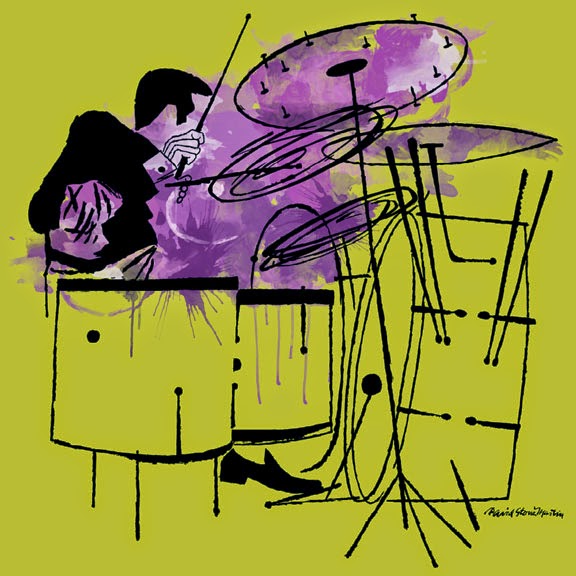
Record album cover by David Stone Martin

Gregory Hines by Jules Feiffer

Helen Frankenthaler, Seascape with Dunes, 1962 
Grey Art Gallery, New York University Art Collection

When I was in art school in the abstract expressionist 1960s, artists
who used line for imagery were dismissed as illustrators. Frankenthaler's
abstract lines in oil had more perceived value than Feiffer's "cartoons."

The difference between art and illustration has grown fuzzier over time, which is a good thing. I haven't heard anyone use "commercial artist" as an insult in decades.


In praise of illustrators:
Cotton prints from the same time that  line artists at the top of this page were working.


It's not pure line

but it's pure fun.


A classic: Dandelion by Lucienne Day, early '50s


Monday, September 1, 2014

Modern Print Monday: Maurice Dufrène


Design from the Galeries Lafayette department store's La Maitrise workshop.
Maurice Dufrène (1876-1955) was a French designer who specialized in furniture and interiors. 

He was the artistic director of the La Maitrise (perhaps meaning the Master Workshop) at Paris's Galeries Lafayette in the 1920s and '30s.  It's difficult to figure out if Dufrène actually designed the fabrics or supervised a staff of like-minded individuals.
Dufrene furniture

An ivory chair

 The furnishing prints I've seen on his chairs have a 
certain sensibility that defines French modernism.

Dufrène followed the trends in French design, moving from Art Nouveau's curving ornament to a more modern minimalism. Throughout his work you find an emphasis on line.

China designed by Dufrene


He published plates with his earlier Art Nouveau design ideas.

Two colorways of a later Dufrène design

Dufrène room at a 1937 design exposition


Sprig carpet, mid-30s.
Order a copy of this design:


This piece is attributed to Dufrène by Christies.


Note the insects among the flowers.