Thursday, June 20, 2013

Modern Needlework: Arts & Crafts Embroidery

Arts and Crafts Embroidery on linen
See a free pattern for the center pillow design below.

Jessie Newbery (1864-1948) was  head of the embroidery department at the Glasgow School of Art in Scotland. Not many art schools consider an embroidery department a necessity but the great thing about Glasgow a century ago was that traditional women's arts were considered on a par with those traditionally done by men. Newbery and the Glasgow School created a new style of embroidery.


Cushion Cover by Jessie Newbery in The Studio 1901

See a different version of this embroidery at the Glasgow Museums site:

 Newbery's designs were published in the influential English magazine The Studio.


Thanks to the "New Embroidery" early modern interiors required many hand-embroidered sofa pillows.
The one above seems to be bound with a contrasting cord.

The stylized floral pillow on the right has a fringed finish.


Glasgow School Design characteristics included filled embroidery on linen grounds with stylized florals of elongated and sinuous shapes. Florals were defined by shape with a minimum of naturalistic shading.  Mottoes were stitched in distinctive arts and crafts type fonts. The original for this embroidery had sweet peas framing the motto. I simplified it by substituting stylized roses, Glasgow Roses.

For a pattern: Click on the picture directly above and copy it to a JPG or a Word file. Then print it out about 11" x 8-1/2".
Or click here for a PDF from Workspaces at Acrobat.

The Glasgow embroiderers used a variety of stitches, but the most common was called the Kensington stitch. See a tutorial here:

And view another of Newbery's cushion covers at the Victoria & Albert Museum

Monday, June 17, 2013

Modern Print Monday: Jacqueline Groag

Unnamed by Jacqueline Groag, 1952

Jacqueline Groag
1903-1986

This design of rounded squares printed on rayon for the English firm David Whitehead, Ltd., is now called "Pebbles." Wind- and water-worn stones may have been her inspiration. 

But others see technology...
Above a 1948 television.


The rounded square is Groag's signature print,
on the cover of two books about her.

She's also the subject of a show up right now at the Denver Art Museum.
Pattern Play: The Contemporary Designs of Jacqueline Groag will close on September 22, 2013.


See more about her at the Worn Through blog:

Born Hilde Pilke in Prague, she studied under Josef Hoffmann at the Wiener Werkstatte in Austria in the late 1920s. She designed for that workshop under her married name Hilde Blumberger. In 1937 she moved to Paris and designed prints for Schiaparelli and Lanvin. In 1939 she and her second husband, architect Jacques Groag, moved to London to escape Hitler's Europe.


She was one of the post-War British designers
who defined "Contemporary Prints."


The rounded square and rectangle mean mid-century modern to us.
Above, vinyl decals for today's modern decor.

Did Groag invent the rounded square?

No, it was in the air.
Above sculpture by Kenneth Armitage from the early 1950s.

Sonia Delaunay 1929

And you can always go back to Sonia Delaunay and see that she thought of it too 20 years earlier. (She seems to have thought of everything.)

Mechtildes By Frederick Etchells
1913
As did the Omega Workshop designers in the early teens.

But the rounded square became THE shape in the 1950s,
found in the heavy furnishing fabrics we call barkcloth...

And trickling down to feedsack prints.

In their 1960 catalog Montgomery Ward's described desirable design:

"Modern, rounded square shapes in pure white sparked by the glow of warm color..."


Thursday, June 13, 2013

Principles of Modernism: Minimalism

Quilt top from the 1970s
Minimalism is a term that describes a composition with few elements.

Sonia Delaunay
JoJo 1969

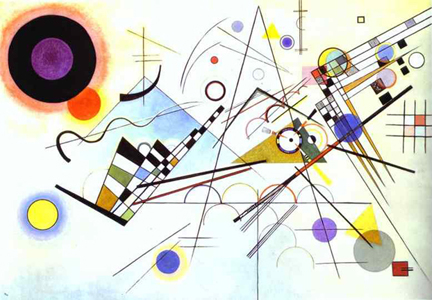
Wassily Kandinsky 
Composition VIII 1923

Modernists pushing abstraction tried to eliminate the non-essentials. Some theorized that the essentials involved only basic color and basic shapes. Basic color included the primaries: red, blue and yellow. Basic shapes were circles, squares, triangles and rectangles.

Study for an exhibit poster about the Bauhaus
by Herbert Bayer

Detail of a Mondrian painting

Piet Mondrian's work is classic minimalism.

Trylon and Perisphere from the 1939 New York World's Fair
by architects Wallace Harrison and J. Andre Fouilhoux.
Two primary colors, two primary shapes.

Quilts often do minimalism as well or better than any artist struggling to get rid of the non-essentials.


Circles & Squares


Triangles


See a classic triangle quilt by Annie Pettway here:


Textile prints were also influenced by minimalism.
Sophia Loren

The  black and white polka dot is the classic minimalist print---
no color, just circles.
Designers reduced the figure to the basics.

From the Wiener Werkstatte
(Viennese Workshop)
Metropolitan Museum of Art
See more of their impressive WW collection by clicking here:

Feedsack print about 1950

More minimalism in 20th-century quilts:


Silkscreen paper print by Laszlo Maholy-Nagy

Read more about Minimalism here at the Museum of Modern Art's webpage

And see a  page of Gee's Bend quilts, masterpieces of minimalism, at Auburn University's site:

Furniture designed by Norman Bel Geddes in 1933.

Variation with squares instead of circles.

Monday, June 10, 2013

Modern Print Monday: Enid Marx

Rope 
Enid Marx
England

Enid Marx (1908-1992) hand printed textiles and eventually became an industrial designer in London. "Rope" must have originated as one of her hand-printed woodblock designs.

The Victoria & Albert Museum has several pieces of her work. Do a search for her name:
http://collections.vam.ac.uk/

And here's a little information about her work:
http://universityofglasgowlibrary.wordpress.com/2011/01/21/friday-gem-from-the-stoddard-%E2%80%93-templeton-design-archive-enid-marx/

Marx also designed papers for books.

Thursday, June 6, 2013

Unmodulated Color in Today's Modern Quilts

A quilt top, probably from the 1930s made from the
 Laura Wheeler/Alice Brooks pattern
Japanese Morning Glory
(#800 in BlockBase)

For the past few weeks I've been talking about the use of flat areas of color in modern design and how 20th-century quiltmakers chose fabrics to fit into that idea. The pieced quilt above with its simple floral and solid-colored cotton follows two important principles of modernism---abstraction and flat color.


Construction Cranes
Claudia Mazur

Claudia showed this quilt at our guild exhibit recently. She has abstracted a set of construction cranes and their color into a very graphic wall quilt. Today we can have color-fast solids in any shade and people are making the most of them.

Chantelle had this Flashburn quilt for sale on Etsy.


Convergence
Annette Guerrero

The use of  vivid color adds to the graphic qualities.
See more of Annette's use of solids at her website

Dark Star
Maura G. Ambrose

But even muted color looks modern if there is little to no pattern in the fabrics as in this prizewinner at QuiltCon.


Dinner Bell
By Jenifer Dick

So whether the shapes are extremely abstract or not, the use of saturated and solid fabrics looks modern.


Cover quilts for Quilt Retro
by Jenifer Dick

You see the bird in 19th-century applique but nobody is going to mistake the cover quilt for a 19th-century antique. See Jenifer's blog here:

See one of Kathleen Probst's quilts using solids and near solids here:

The Modern Quilt Guild has been blogging about solid colors. Here's a post:

Monday, June 3, 2013

Modern Print Monday: Poiret & Atelier Martine

Unnamed print 1913
from the Atelier Martine under Paul Poiret,
Paris

The classic floral reduced to basic shapes.

Paul Poiret (1879-1944)

Couturier Paul Poiret completely changed fashion. Not only did he revolutionize the dress silhouette, jettisoning corsets and introducing what became known as the "hobble skirt,"he had a genius for using the modern prints that European designers were producing.


In love with the simplicity of folk arts he began the Atelier Martine, (Studio Martine) named for his daughter, where he staffed the design department with young girls who had no artistic training---an iffy and condescending concept---but one that seems to have worked.


Read about Poiret and the Atelier Martine at the Metropolitan Museum of Art:
At Printeresting


And in Lesley Jackson's Twentieth-Century Pattern Design on page 47