
Thursday, June 12, 2014

Color Fashion: Wright Palette in Feedsacks

Feedsack ca 1950

Frank Lloyd Wright Usonian House

One of modernism's principles was the idea of enabling the middle class to enjoy the same stylish design as the upper classes, a theory architect Frank Lloyd Wright incorporated into his line of small, efficient Usonian houses begun during the Great Depression.


Wright's design ideas---rooms open to nature, built-in furniture, wood and window walls, concrete, and carports rather than garages---became the standard for middle class housing after World War II.
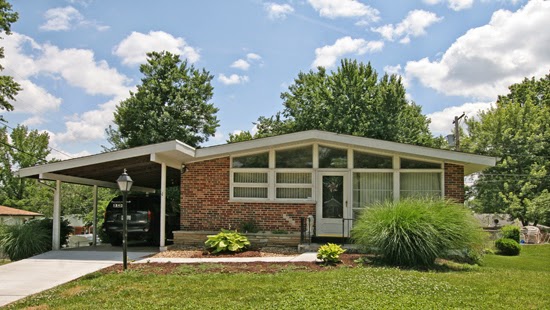
Modern architecture became so commonplace its innovative qualities became difficult to see. The problem with the principle of widespread innovative design is that it eventually becomes mundane.

I think of feedsack prints as the ultimate in trickle-down design. In these examples we see the influence of the Wright palette (Russel & Frank.)


From an autograph quilt dated 1954

Monday, June 9, 2014

Modern Print Monday: Henry Moore

Henry Moore, 
Treble Clef, Zig-Zag and Oval Safety Pins, 1946

Henry Moore (1898-1986) England

Henry Moore is best known as a sculptor who combined modernism's ideals and the 3-dimensional human figure, but he also designed prints for dresses, scarves and interior design.


Henry Moore, Barbwire for Ascher Studios, about 1943,
printed on an austerity rayon fabric

Actress Sally Davis costumed in Barbwire in the 1947 film 
They Made Me a Fugitive

Henry Moore, silk scarf for Ascher Ltd., 1946

Moore was one of the well-known artists whom Zika and Lida Ascher commissioned to create designs for scarves during World War II. See more of his Ascher Art Squares here:


Moore became interested in repeat patterns that could be printed inexpensively to dress the middle class and furnish their houses.

Family Group scarf from Ascher, Ltd.

See the Moore collection at the Victoria and Albert Museum


Read more here:


Thursday, June 5, 2014

Color Fashion: The Wright Combination


Barkcloth quilt
perhaps from the early 1950s

Post-war style was more than just chartreuse. The perfect fifties color palette featured greens from acid yellow to dark hunter green played against gray with pink, peach and reds for accent.

The Rusell Wright palette derived from his china and pottery.


The trend compelled the stylish to cover their hardwood
floors with linoleum tiles.

and paint their garage doors to match their cars.


Vintage linen dress

Russel Wright dishes at his home Manitoga


Quilt from the era

The more inexpensive version of the Wright pottery look was Franciscan's Tiempo line,
introduced in 1948.


Russel Wright wasn't the only Wright influencing color
at the time. Here's the current interior of Frank Lloyd Wright's
Bachman Wilson house of 1954.


Vogue 1952


Bark cloth bathrobe


Alarmingly trendy vintage decorating fabric

Tied comforter from the era.

Embroidered strip quilt dated 1959


Monday, June 2, 2014

Modern Print Monday: Maurice Pillard Verneuil


Nasturiums by Maurice Pillard Verneuil, late 19th century, France


Maurice Pillard Verneuil (1869–1942)
Daughter Vivianne was born in 1910.

Verneuil was born in Saint-Quentin dans l'Aisne in northern France. In Paris he studied at L'École Guérin under Art Nouveau graphic artist Eugène Grasse. Verneuil and Alphonse Mucha developed Grasse's ideas and imagery into the 20th century.


Floral repeats from Verneuil's pattern books


About 1920 he opened a studio and school in Switzerland in Chexbres overlooking Lake Geneva (Lac Léman). He remained in Switzerland until his death in 1942. His birth name was probably Pillard and he added the Verneuil later. A French reference: (Verneuil, Maurice pseudonyme de Pillard)

Design for Stencil, 1910


We know Verneuil mainly because of his many pattern books published between 1896 and 1927.

Animals in Design was published in 1897


Kaleidoscope: Abstract Ornament
was published in 1926...


Influenced by the 1925 Exposition Internationale des Arts Décoratifs.


A repeat pattern from Kaleidoscope
(Very Charles Rennie Mackintosh)


Verneuil's designs were republished in the late-20th-century revival of interest in Art Nouveau.

Verneuil did not actually design textiles that went into production but his design books influenced many artists who did produce wallpapers and fabrics.


With Alphonse Mucha and Georges Auriol he published a 1910 book on design repeat called Combinaisons ornementales or Ornamental Combinations Multiplied to Infinity with a Mirror.


Read Combinaisons Ornementales at the Internet Archive here:
https://archive.org/details/CombinaisonsOrnementales

The New York Public Library has many Vernueil plates in their online collection:
http://digitalgallery.nypl.org/nypldigital/dgkeysearchresult.cfm?word=14042&s=1&notword=&f=13&sScope=Name&sLabel=Verneuil%2C%20M%2E%20P%2E%20%28Maurice%20Pillard%29

See more here in French:
http://www.meublepeint.com/maurice-pillard-verneuil.htm


You can buy a scarf derived from Verneuil's designs at the Metropolitan Museum Gift Shop:
http://store.metmuseum.org/neckerchiefs/art-nouveau-swirls-neckerchief/invt/80016232#.U4Hm3fldXJ4

A list in French of Verneuil's pattern books:
1897 Dictionnaire des symboles emblèmes et attributs, Éditions Slatkine
1898 L'animal dans la décoration, Ed. A.Lévy
1904 Documents ornementaux (publié sous la direction de M. Pillard Verneuil), Librairie Centrale des Beaux-Arts
1908 Étude de la plante, Librairie Centrale des Beaux Arts
1910 Étoffes japonaises tissées et brochées
1910 L'ornementation par le pochoir, Éditions Schmid et Laurens
1910 Combinaisons ornementales , Librairie Centrale des Beaux-Arts
1913 Le livre de la mer illustré, Librairie Centrale des Beaux-Arts
1927 L'art à Java : les temples de la période classique indo-javanaise, Éditions Vanoest