Thursday, April 10, 2014

Celebrating Science: Atomic Prints


Celebrating science became a fad in the early fifties with "atomic design,"

adopting the atomic diagram with all those protons, neutrons
and electrons floating around in neat, elliptical orbits.

Vintage dress

Vintage radio
Was it a starburst or a sunburst?

Franciscan Starburst pattern

and fabric tablecloth to go with it.

Formica


It's hard to understand the charm of atomic bombs.


Atomic Fire Ball gum
complete with mushroom cloud


But those of us who grew up hoping a wobbly desk
would protect us from the inevitable Cold War attack
recall how the images permeated the culture.


Vintage barkcloth

Weird Science indeed.


 I bet these pieces of barkcloth are reproductions. They are almost too hip to be true.


There really isn't that much atomic imagery on fabric from the fifties but the word "Atomic" is now used to describe any of the abstract modern prints---
any high-style fifties design.

Atomic Ranch magazine


Monday, April 7, 2014

Modern Print Monday: Rockwell Kent


Harvest Time
by Rockwell Kent for Bloomcraft, Inc., 1950

Rockwell Kent (1882- 1971) Self-portrait.
New York


Kent is remembered today as a book illustrator, particularly for his prints for Moby Dick.

He was also a print maker and a painter.

Mount Equinox, Winter, 1921
Collection of the Art Institute of Chicago

Like Thomas Hart Benton and Grant Wood he worked in a regionalist style capturing familiar landscapes and idealizing rural life.

Deer Season, 1950


Deer Season and Harvest Time are two prints representing Kent
at this year's exhibit Artists' Textiles at London's Fashion and Textile Museum


Read about the exhibit which closes on May 17, 2014.

The Metropolitan Museum has several painted
designs for fabric. Were they ever produced?

http://www.metmuseum.org/Collections/search-the-collections/359257?rpp=20&pg=1&ao=on&ft=rockwell+kent&pos=12

The Philadelphia Museum of Art has quite a collection of Kent pieces:
http://www.philamuseum.org/collections/results.html?results=54&searchTxt=rockwell%2Bkent&searchNameID=&searchClassID=&provenance=0&audio=0&searchOrigin=&searchDeptID=&page=1&action=post

The Plattsburgh State Art Museum (SUNY) also has collections of works on paper, canvas and a few textiles.
http://clubs.plattsburgh.edu/museum/rk_exhib.htm


Thursday, April 3, 2014

Principles of Modernism: Celebrating Science

Atomic by Tibor Reich, 1951

Pattern artists have always been inspired by nature, but in 1951 a group of British designers copied the natural world in designs based on x-ray crystallography.

Lesley Jackson's book From Atoms to Patterns
discusses this cooperative work between
scientists and patternists
 for the 1951 Festival of Britain


Flamingo, Tibor Reich 1957
Collection of the Victoria and Albert Museum
The interest in scientific images was encouraged by screen 
printing using photographic processes.

It looks like pattern designers have been looking for ideas through
microscopes for generations.

Early-19th-century prints in coral style.

This one from the Powerhouse Museum files....

With better microscopes, a closer look:

Fabric by S.M. Slade, 1951
based on the atomic structure of the metal afwillite.

Read more:


Monday, March 31, 2014

Modern Print Monday: Gustav Klimt

Gustav Klimt, Vienna
Swatch of printed fabric with imagery recalling The Kiss.
Collection of the Metropolitan Museum of Art.

Gustav Klimt (1862–1918) and Emilie Flöge,
his long-time companion, about 1905.

Gustav Klimt is best known today for his 1908-9
painting "The Kiss," a very decorative and romantic
image.

His Tree of Life from 1909 has inspired numerous
textile designers in recent years...


Klimt designed his own repeat pattern but very little evidence of this survives. The Metropolitan Museum of Art has a small collection of swatches, printed by the Wiener Werkstatte (Viennese  Workshop.) The catalog says these are from about 1920 but Klimt was dead by then, a victim of the 1918 influenza epidemic. I'd guess they were more likely from about 1910.

Because they are relatively small samples of a large repeat we
 get no idea of the overall design.


The collection appears to be four prints in different colorways.

See the Metropolitan Museum's collection of works by Klimt by clicking here:

The rare samples were a gift from Joanne F. du Pont and John F. Pleasants, in memory of Enos Rogers Pleasants, III, 1984

Thursday, March 27, 2014

Prints As Propaganda

Dress made of Arnold Lever's Victory Fabric, 1945,
picturing the flags of the Allies in World War II.

London Walls print By Arnold Lever for a scarf for Jacqmar, which
did a series of English patriotic/propaganda scarves
during World War II.

Uncut kimono fabric,
Japan, early 1940s

Propaganda seems a harsh word. We feel most comfortable using it to describe ideas we don't care for rather than values we hold dear. 

Another Lever/Jacqmar collaboration

Perspective rests on a sliding scale between Patriotic and Propaganda and each viewer has to decide where to situate herself as she views the imagery.

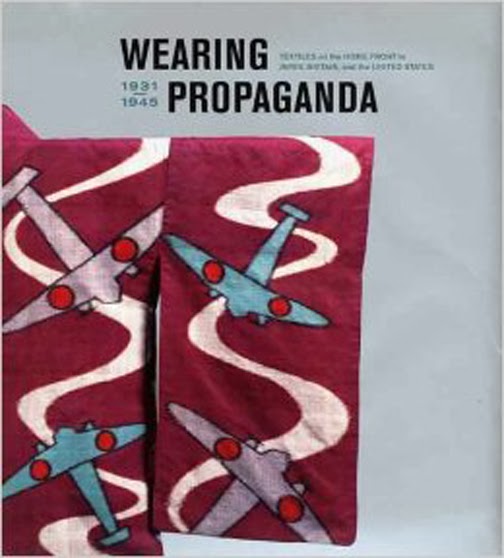
These images of Japanese kimono from World War II
are from
Wearing Propaganda: Textiles on the Home Front in 
Japan, Britain, and the United States, 1931-1945


Printed yardage V For Victory from the collection
of the Victoria and Albert Museum


At least two V for Victory American prints have been documented.

Feedsack print from the Rick Rack Rag
Both use Morse code for V
..._

Percy Kent's 1942 feedsack print
Cloth of the United Nations must have been a good seller,
based on the number of surviving examples.


To the die-hard modernist, however, any use of art for the sake of the state was an unwelcome return to the past.


Read more about prints as propaganda in Jacqueline Atkins's catalog Wearing Propaganda: Textiles on the Home Front in Japan, Britain, and the United States, 1931-1945

See pictures from the exhibit:
http://www.designboom.com/history/propaganda.html

http://the.honoluluadvertiser.com/article/2007/Mar/11/il/FP703110326.html


See also Beauty as Duty (2011)  by Alexandra Huff and Frederic Sharf, catalog to an exhibit at the Boston Museum of Fine Arts:
http://fileunderfiber.blogspot.com/2011_12_01_archive.html

Read more about the Jacqmar scarves:http://alfiesantiques.blogspot.com/2014/01/propaganda-scarves.html