Monday, March 17, 2014

Modern Print Monday: Mila Schön


Print by Mila Schön
Milan

Mila Schön (1915-2008)

Once well-to-do,  Schön supported her family after a divorce by opening a fashion house in the late 1950s.
This print is probably one of a series Schön did
that was influenced by color field painter Kenneth Noland

Kenneth Noland, Lovely Rosa, 1983


 Schön's prints and patchwork clothing will
be featured in an exhibit
The Glamour of Italian Fashion at the 
Victoria and Albert Museum
in London from
April 5 through July 27, 2014


Mila Schön  in 2012

The Mila Schön house continues to follow her ideas:
http://www.milaschon.com/blog/

Thursday, March 13, 2014

Quilt Borders: Opening It Up

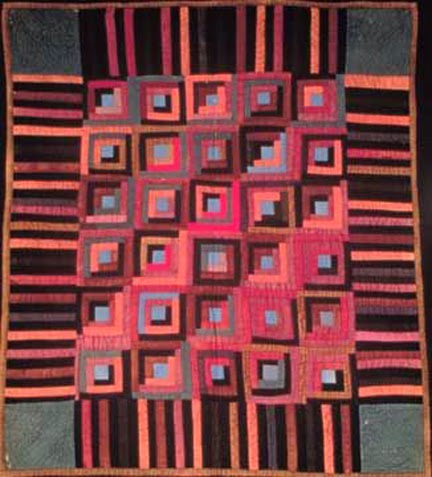
Quilt about 1900 from M. Finkel & Daughter

The placid green border corrals a dynamic design.
Would the composition be better with or without the
green border? It's probably a matter of taste.

A red paisley border on three sides confines this
top from about 1900, creating tension between
pattern and frame.

Borders can introduce a calming or static quality to a composition.


Borders are such a strong design element
that taking liberties with them
creates new dynamics.

Vintage top

Today's quilt artists play against that visual corral.

Blue City Quilt
by Thomas Knauer
(Many of these photos were taken at last year's QuiltCon)

http://www.thomasknauersews.com/

Breaking the border can be an effective design principle.

Off Centered Improv by Faith Jones

2 + 2 by Colleen Wootton

Border remnants also introduce an interesting element

by Alicia Merrett

by Alicia Merrett

http://www.sewn.eu/en-us/haveasay/guestcorner/aliciamerrett.aspx

Shattered by Jacquie Gering

Displacing the border....

Unraveled by Kati Spencer

Isn't that the border in the middle of the quilt?

Lanterns in the City by Audrie Bidwell


Monday, March 10, 2014

Modern Print Monday: Cecil Beaton


Garbo's Eyes from a sketch by Cecil Beaton

A new line inspired by Cecil Beaton's
sketches is available as wallpaper and fabric.

  Sir Cecil Walter Hardy Beaton , 1904-80
England

Beaton was known for a certain casual, sketchy drawing style

Pansy from Cecil Beaton Fabric

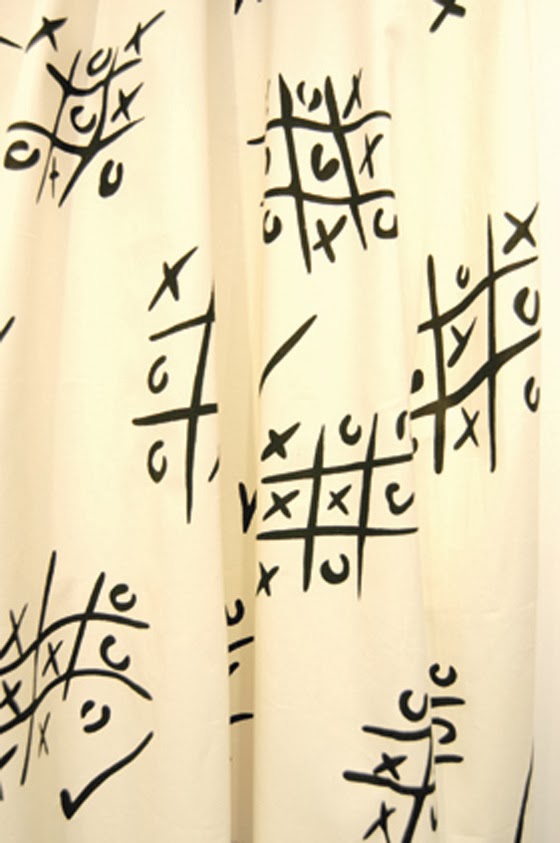
Tic-Tac-Toe from Cecil Beaton Fabric

He wasn't really a pattern designer, but he
 created a look that is adaptable
to fabrics.

Vogue Cover by Beaton, 1938

Vogue, 1949

Publicity Still for My Fair Lady, 1964
In later years he became a set, film and costume designer, notably for Gigi and
My Fair Lady.

Nancy Cunard, 1929

He first became known for his fabulous portraits combining geometry, lighting and dramatic sitters. He also documented Britain in World War II.


Sailor sewing aboard ship

Thursday, March 6, 2014

Frames and Borders: Modern Quilts


Sarah Furman Warner quilt
Collection of the Metropolitan Museum of Art

Elaborate borders are a hallmark of quilts made before the
Civil War.

Quilt dated 1847 Mary Ann Grooms

Amish crib quilt, Illinois State Museum
The Amish working after 1880 also emphasized
wide borders.

Although these quilts were designed for beds,
their borders give them a neat, framed finish.
The blue "spacer" border  with wider outer border has become
a standard for quiltmakers in recent decades.

Amish quilt show at the Textile Museum

Paintings by Clyfford Still
In contrast to abstract painting exhibited with no frames...

Robert Motherwell paintings at the Museum of Modern Art

...or minimal frames of strips of wood or metal.

Prism by Weeks Ringle and Bill Kerr

Many modern quilters advocate an unframed composition.

Among them Weeks Ringle and Bill Kerr

 Read a preview and note their discussion of borders and "Engaging the Edge" on pages 13-15 of The Modern Quilt Workshop: Patterns. Click on the link below.

"Many designs become static when surrounded by borders."

http://books.google.com/books?id=xTLKr6nMTfMC&pg=PA15&lpg=PA15&dq=modern+quilt+border&source=bl&ots=qMbCcqlzEn&sig=fPX42MaKUGvTfwD05ePop7tHHmY&hl=en&sa=X&ei=0KIHU6H1Gqr4yAGf84HwCA&ved=0CIABEOgBMAs#v=onepage&q=modern%20quilt%20border&f=false

Monday, March 3, 2014

Modern Print Monday: Eszter Haraszty


Eszter Haraszty, Tracy, 1952
Screen-printed Cotton

Eszter Haraszty (1920-1994)

Born in Hungary, Eszter Haraszty attended the University of Fine Arts in Budapest and worked in costume design before immigrating to New York in 1946. She was Knoll's director of textiles from 1949 to 1955 where she designed innovative prints for their up-scale furniture lines.

Triad, screen printed linen, 1955 
Collection of the Museum of Modern Art

Fibra Screen printed linen, 1953,
Collection of the Cooper-Hewitt.

See the holdings of the two museums by clicking on each:
https://collection.cooperhewitt.org/people/18063143/objects/
http://www.moma.org/search/collection?query=haraszty

The 1950s became the 1960s, and Haraszty moved to Southern California to garden. She became well-known for her stitchery, focusing on poppies.


Designing kits for Bucilla


and McCall's

They didn't call it Poppy Power for nothing...

Californians know poppies can be invasive.

Cathy likes the poppy look:
http://cathyofcalifornia.typepad.com/cathy_of_california/2011/08/eszter-haraszty-texile-designer-stitcher-style-icon-and-lover-of-poppies.html