Thursday, February 6, 2014

Principles of Modernism: Asymmetry

Monticello by Thomas Jefferson
Symmetry is a basic principle of classical design.

Leonardo DiVinci
The Last Supper

Buildings and paintings often are based on mirror-image symmetry
where each side reflects the other.
St. Albans Cathedral

Something we see in traditional quilt patterns
in which the sides are identical but flipped as a mirror image.

Bilateral symmetry gives a composition a solidity and
sedateness.


Or perhaps a dull and static quality,

Falling Water by Frank Lloyd Wright

One reason modern architects explored the asymmetrical building.

And fashion designers the asymmetrical garment.

Louise Brooks


Picasso dress for White Stag
1963

See a how-to on using asymmetry in design by clicking here:

Monday, February 3, 2014

Modern Print Monday: Andy Warhol


Watermelon by Andy Warhol for Fuller Fabrics, about 1956

Andy Warhol, New York
1928-1987

Before he was a celebrity fine artist, Andy Warhol was a successful graphic designer who did a series of repeat cotton prints for Fuller in the mid-1950s.

Happy Bug Day series


Warhol's textile designs are among the pieces being shown at London's Fashion and Textile Museum exhibit Artist Textiles: Picasso to Warhol, which opened this week. The exhibit will come down on May 17, 2014.

"This exhibition traces the history of 20th century art in textiles. Highlights include work by Georges Braque, Alexander Calder, Marc Chagall, Salvador Dalí, Sonia Delaunay, Raoul Dufy, Barbara Hepworth, Fernand Léger, Henri Matisse, Joan Miró, Henry Moore, Pablo Picasso, Ben Nicholson and Andy Warhol."

Read more here:

And see more of Warhol's graphic design here:


Thursday, January 30, 2014

The Primitive Look

Patchwork made of imitation patchwork
 in Pennsylvania Dutch style

From 1940 to 1970 the folkloric look was a prominent trend
in American decorating. The Tyrolean-style feedsack above
celebrated Swiss rural costume, frozen in time...

Franz von Defregger
Young Man in Tyrolean Costume, 1872

which was mixed with the Pennsylvania Dutch
nostalgia.

Feedsack

A new generation of artists and collectors who'd grown up with
Pennsylvania Dutch/Tyrolean kitchen curtains began collecting an edgier folkart...

Drawing by Bill Traylor

including art by living artists who became known
as outsider artists.

Painting by Sam Doyle

Textiles with an edge included quilts...

Wool applique quilt dated 1896
...particularly appliqued quilts

Early 20th century applique quilt

Early 20th century applique mat

Hooked rugs also became very collectible.


In the 1980s a new style of quilt appeared, driven by designers with art school backgrounds and a love for naive art. We call the quilt style primitive, using a word that goes back to John Ruskin's term for pre-Renaissance Italian art in 1850.

Spring Has Sprung by Jan Patek

Characteristics of primitive style included out-of-scale imagery, flat color, and simple shapes with asymmetrical forms.

A fresh look at icons of folk art included misshapen stars characteristic of Linda Brannock and Jan Patek ...

and elongated hearts. 
Here a quilt by Lissa Alexander at Moda.

Pattern for Lisa DeBee Schiller's
Liberty Garden


New machine techniques and old ideas inspired an applique revival. 

The look might be "primitive" but the color and design
were quite sophisticated.

Camp Reveille from Blackbird Designs

Hooked rug about 1910
featuring elongated florals. Stretched out imagery
is a hallmark of the current primitive look.

Hooked rug about 1910

Tile quilt top dated 1893 featuring silhouetted shapes

Recent quilts in the Primitive Style:

Liberty's Eagle by Karla Menaugh and Barbara Brackman
Red white and tan

Pomegranates and Berries by Jan Patek

The colors in the primitive movement are muted, based on faded dyes and washed out
browns and tans, quite a contrast to the super-bright super-graphics of the 1970s.

Jo Morton
Tans were the neutrals; whites almost forgotten.

The primitive look evolved into the 21st century with a color revival
Blackbird Design booth capturing the primitive look
in the twenty-teens.

Lisa Bongean's Evelyn's Album

Sue Spargo combines primitive florals with vivid color.

As white recycles into favor and color makes a comeback we will surely see style changes in future primitive quilts.
Is anyone ready for a Tyrolean revival?
Monday, January 27, 2014

Modern Print Monday: Dora Batty

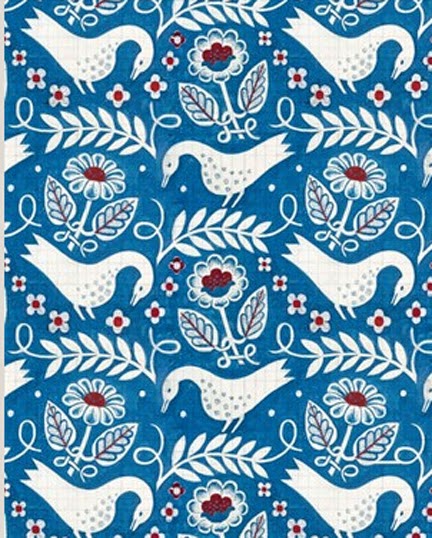
Hurstwood by Dora Batty, London

Dora Batty (1887? or 1900-1966) was an influential teacher at London design schools from the 1930s through the '50s, head of the Textile Design Department at the Central School of Art.  She is best known for a series of posters she did for the London Underground.


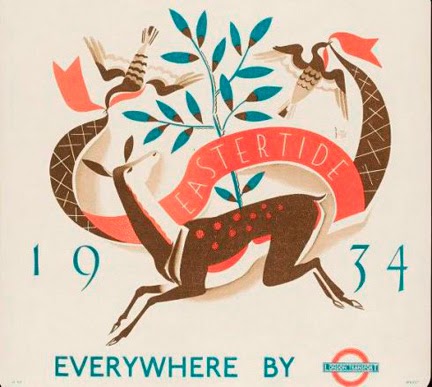
London Transport Poster by Dora Batty

She used a variety of modern styles in her posters, ceramics and textiles. 

Those pictured here are what might be called folkloric modernism, stylized imagery drawn from traditional Eastern European abstractions of nature. Modern yet nostalgic, folkloric abstractions were pioneered by Vienna's Wiener Werkstatte at the beginning of the century and quite popular after World War II.


Starlings by Dora Batty

Because so little is written about Dora Batty we don't know if she was creating trends in the late 1940s or simply expanding upon popular ideas.


Framlingham by Dora Batty, 1951


Feedsack with folkloric imagery

Batty's imagery fits into the trend for folkloric prints 
called Pennsylvania Dutch in post-war America.

The imagery is still popular today, as in this Japanese print from 
Lecien in their My FolkLore series.

See Sally Ann Parker's search for facts about Dora Batty here: